
If you’ve been told it’s ‘just anxiety’
Once you know why panic makes your heart race, it stops feeling like an emergency
Every attack you can’t explain makes you check your pulse and your breathing more often.
In 13 short videos I go through what your heart, your breathing and the CO2 in your blood are doing when panic hits, so you can stop lying awake at 3am wondering what the doctors missed.
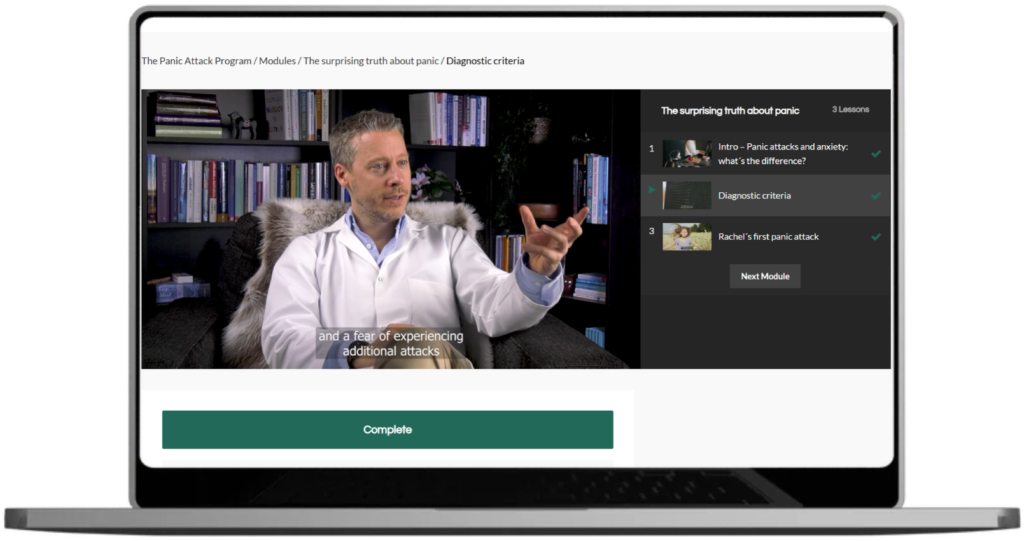
I’m Robert Bernhardsson, licensed psychologist.
You’ve probably been told it isn’t dangerous. But nobody explained why your heart races, why you can’t get enough air, or why every test comes back normal. After more than 1,000 sessions with panic, I explain what happens in your body before the fear even kicks in.
One-time payment · 30-day money-back guarantee

No diagnosis needed
Lifetime access
Watch it tonight
You’re on the couch on a quiet Sunday evening, nothing going on, and your heart starts pounding out of nowhere. Your hands tingle, you can’t get a full breath, and your chest feels tight.
At the ER they checked your oxygen and it was perfect, while you sat there feeling like you were suffocating. Every test came back normal, the doctor said it was probably anxiety, and you went home more scared than when you arrived. Part of you still wonders how something that feels this physical can be panic.
Since then you’ve become good at keeping track of yourself. Your breathing, your heartbeat, small things most people never notice. You notice all of them, and every one of them could be the start of the next attack.
Does that sound like the last few months for you? Then looking for a real explanation is exactly the right thing to do. If you’d already been given one, you wouldn’t be here.
Maybe you’ve been put on a waitlist. Maybe a panic specialist costs more than you can spend right now, or there isn’t one anywhere near you. Or maybe you’ve already had help, and nobody walked you through what was actually happening in your body.

Why not knowing keeps the panic going

What do you do the moment your heart skips? Most likely you check. You feel for your pulse, you notice your breathing, you look for the nearest door.
It makes sense that you do. Nobody explained what happened last time, so every skipped beat could be the start of the next attack, and checking feels like the safe thing to do.
Maybe you ask Google or AI. It tells you it isn’t dangerous, and the answer calms you down until the next time.
But think about what happens when you check. The moment you focus on a sensation, it feels stronger. Your heartbeat feels harder, your breath feels shallower, the dizziness feels closer, and now there’s even more to check.
So the checking that was meant to keep you safe ends up being one of the things that keeps your panic going.
This is why the explanation matters more than it sounds. When you know the tingling in your hands comes from how you’ve been breathing, you don’t need to stop and check whether something is wrong with your heart.
Every week it stays unexplained, the checking gets a little more automatic. Start tonight with the part no search gives you: what your breathing has been doing to your blood, long before your heart ever skipped. Everything put together in one place, so you can stop searching.
Once you know this, the next skipped beat stops feeling like the start of an attack.
The psychologist behind this
There’s a moment I’ve seen with hundreds of patients. I explain why their hands tingle on a calm evening, what their breathing has done to the CO2 in their blood, and why every test came back normal. Then they look at me and ask the same thing: “Why has no one told me this before?”
Most of them had been to the ER, read the articles and tried the breathing exercises, and the answer they kept getting was that it’s ‘just anxiety’. That’s the answer that frustrates me most, because it tells you nothing about why your heart is racing. If you’ve been told the same thing, these videos are my answer.
I’m Robert Bernhardsson. I’ve been a licensed psychologist in Sweden since 2016, with a decade of clinical work in psychiatry, primary care and private practice, and training in CBT and exposure therapy. Over time panic became the only thing I work with, more than 1,000 sessions of it, and that’s why I can go further than the general explanation of anxiety you’ll find online.
I take each symptom you’ve been afraid of, the racing heart, the air hunger, the tingling, the burning in your chest, the feeling that nothing is real, and trace it back to what’s happening in your breathing, your blood and your nervous system, in the same order I’d go through it with you in a session.
No diagnosis is required, and there’s no waitlist. If you recognize the racing heart, the checking, or symptoms that don’t make sense, this was made for you.
Clip from the program: why your heart starts racing before you feel scared (53 sec).
What changes when it finally makes sense

From the program: Susan, before her first panic attack.
Susan was standing at the stove with a spoon in her hand when her heart started pounding so hard she called an ambulance. At the hospital every test came back normal.
After that she started listening to her body. In the car, at work, in bed at night. Every time her heart skipped or her chest felt tight, the same thought came back: what if they missed something?
When Susan finally heard what her breathing had been doing to the CO2 in her blood that evening, the pounding heart and the tingling hands had an explanation for the first time.
Have you had that same thought, in the car or in bed at night? Here’s what those moments can look like once you know what your body is doing, all the way down to your breathing and your blood.
“I still feel the sensations sometimes. They just don’t mean something scary anymore.”
“The fear is completely gone. Understanding what was actually happening in my body changed everything. Once I truly understood panic, it lost its power.”
“Not the typical advice. This psychologist goes deep.”
These statements reflect individual experiences and do not represent typical results.
The Complete Physiology of Panic
What you get:
When you asked what was happening to you, what did you hear? Probably “It’s not dangerous, it’s just anxiety,” and maybe a breathing exercise to try.
That’s true, but it doesn’t tell you why your heart was racing on the couch, or why your hands were tingling.
In these videos I give you the full explanation, the one I’d give you if you were sitting across from me.
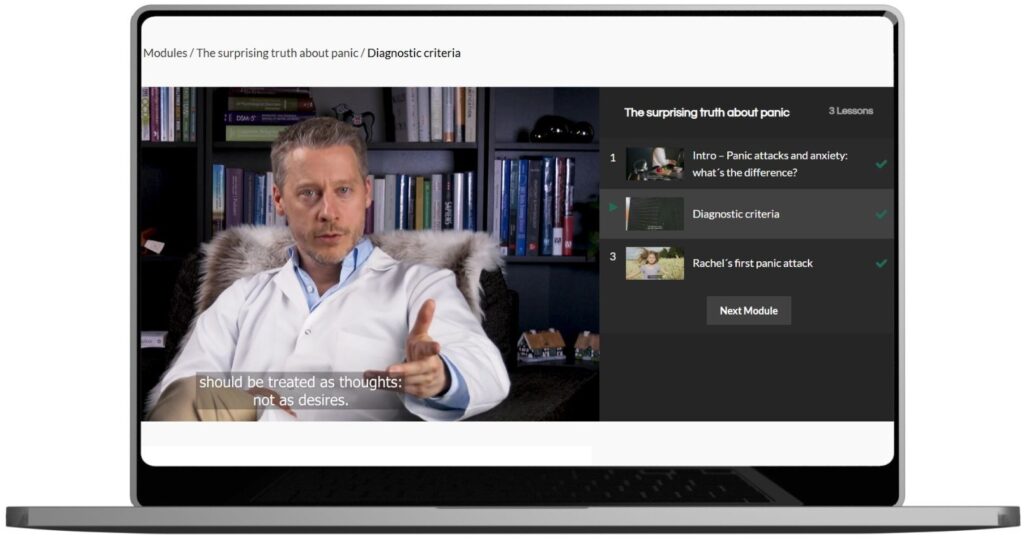
- Relax without waiting for the next attack. Why panic hits when nothing is obviously wrong, on calm days, in the shower or at 3am.
- Feel your heart race and know what it’s doing. Learn how your heart rate, your breathing and the CO2 in your blood together produce the sensations you've been afraid of.
- Get the relief a normal test result should have given you. How panic produces symptoms that feel completely physical.
- Stop fearing every new symptom. Where that tingling, dizziness and the feeling that you can't get enough air actually come from.
- Stop feeling like it can hit at any moment. Why panic feels random when it actually follows a specific and predictable mechanism.
- Stop blaming yourself for a bad night. Why a stressful day can still set off panic at night, hours after the stress is over.
One-time payment · 30-day money-back guarantee
What’s included
- Instant and lifetime access to the complete physiological explanation
- 13 short, focused video modules. Watch at your own pace
- Two clinical cases, following Susan’s and Rachel’s first panic attacks
- 30-day money-back guarantee
Just $29
Less than the cost of a single session with a specialist
This is the complete explanation, and it stands on its own. If you later want to go further with exposure and breathing retraining in my full panic program, the $29 you pay now counts in full toward it.
Your Questions Answered
You'll know what's behind each of your symptoms: why your heart pounds on a calm evening, why your hands tingle, and why the tests come back normal.
Once the sensations make sense, they lose a lot of their power to scare you. This part covers the explanation, and the structured work with exposure and breathing comes in the complete program.
You get instant access. There's nothing to schedule or set up, and you can start watching right away.
Most explanations stop at "it's not dangerous." This one goes into the blood chemistry behind tingling, dizziness and air hunger, and why it happens on a quiet evening. If you've read a lot and still can't explain your own symptoms, that's the gap this fills.
You can, and you'll get a reasonable general answer. Here you get the whole explanation in one place, in the order I'd take you through it in a session, with animations of what happens in the blood and the nervous system and real cases like Susan and Rachel.
This gives you the complete explanation on its own. If you later want structured work with exposure and breathing retraining, that's what my full panic program covers, and the $29 you pay now counts in full toward it.
Email support@gspsychology.com within 30 days for a full refund. No conditions.
No, it’s the opposite. Understanding what your body is doing is the first step in treating panic, because the fear grows out of not knowing. That’s why my work with patients has always started here. Everything is explained calmly, the way I’d go through it with you in person, one symptom at a time.
You might notice your heartbeat or your breathing more while you watch, simply because you’re paying attention to them. You can pause any video and come back to it whenever you want.
Yes. This explains what happens in the body during panic. It doesn't diagnose anything or replace a medical evaluation. If you have chest pain, a racing heart or other symptoms a doctor hasn't looked at, get them checked first. If something feels like an emergency, call your local emergency number.

The first step should
feel safe
30-Day Money-Back Guarantee
Here’s why the guarantee is there. If you’ve already spent time and energy on things that almost worked, you know your hesitation isn’t really about $29.
That’s what the 30 days are for. Watch it and sit with it. If it’s not for you, email support@gspsychology.com within 30 days for a full refund, no conditions.
If you’re reading this, you’ve probably already tried hard to understand what’s happening, and you still don’t have a real answer. This is that answer.
The next time your heart pounds on a quiet evening, you can keep guessing, or you can know what’s happening.
- $29 - One time payment
- Lifetime access
- 30-day money-back guarantee