
Stop planning your life around the next panic attack…
If you know it’s panic and it STILL gets you every time
Then this is for you. You check your pulse, you take the long way home, and at 11pm you google every new symptom. Of course you do, and it works fine in the moment.
But every time you get yourself out of an attack like that, your body just learns that it really was dangerous, and a week later you’re back on the couch with your heart pounding.
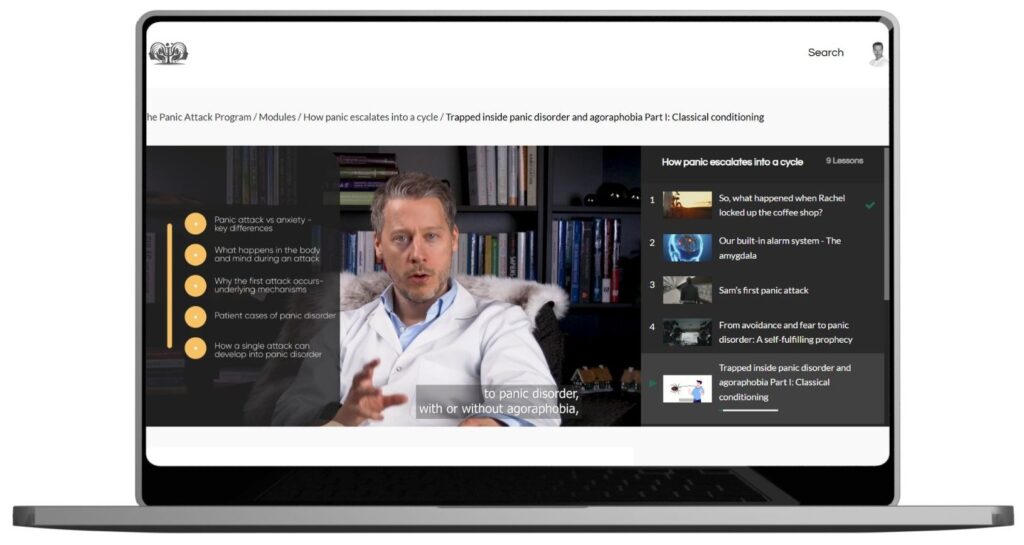
Robert Bernhardsson, licensed psychologist. More than 1,000 sessions with panic, and panic is the only thing I work with.
In 38 videos I take you through everything I do with panic patients, from why each symptom happens to how you get your life back, and you actually do it, at your own pace. If you get stuck, you email me.
Picture a few months from now. Your heart speeds up on the couch, and you keep watching your show. You take the highway because it’s faster, you get through a whole Sunday without googling a single symptom, and you start to feel like YOURSELF again.
One-time payment · 30-day money-back guarantee

No diagnosis needed
Built specifically for panic
Start watching tonight
Lifetime access
Which one sounds like you?
After more than 1,000 sessions with panic, I know you’re probably nodding along to at least one of these (maybe all three).
You know it's panic, and it still gets you
When did you last check your pulse? Today, probably (maybe even while reading this). Your watch says 112 while you’re just sitting there, and even after the EKG, more than once, there’s that voice: what if they missed something?
You’ve read the books, you could explain adrenaline to anyone.
And STILL, in the back row at a meeting, your chest tightens and for thirty seconds everything you know is just… gone.
You have an excuse for everything
Which excuse do you use the most? “I prefer to drive.” “The kids have practice.” “I’ve got a migraine.”
They’re good excuses (people with panic get very, very good at them), but you know what they’re covering.
On the train you stand by the doors, ready to get off at the next stop the second your breathing changes. And the kids are counting down to a trip you just can’t picture yourself on.
Your panic keeps changing
Does it hit right when you finally relax, on the couch or in the shower?
First your heart, then the rocking-boat feeling, the lump in your throat, a jolt like an electric shock outside the grocery store.
And then there’s the part you might never have said out loud: the room goes strange, and for thirty seconds you’re sure you’re losing your mind (if that’s you, that feeling has its own video in my program).
What has panic taken from you?
Whichever card felt like yours, think about this for a second. What did you use to do that you don’t do anymore? The run, the morning coffee, the trip, a movie on the couch without thinking about your heart? Take a second with that one.
And that list rarely stays the same. First it’s the highway, then the train, then the dinner you say no to before anyone even asks.
And the attacks themselves? When one is at its worst, you KNOW it’s panic, and you’re still sure you’re about to die. Afterward you sit there wondering what’s wrong with you, and the next morning you go to work and nobody has a clue (you’ve gotten really good at giving a reason that sounds better than the real one).
If you thought of something on that list, I want to tell you what I think is really going on, because I think the advice you’ve been given is a big part of why your panic keeps coming back.
Why your panic keeps coming back
“It’s not dangerous. You’re not having a heart attack. Just breathe.”
You’ve probably heard both more times than you can count. And you’ve done everything right: the slow breathing, the cold water, grounding, an app, getting up and walking it off, maybe therapy with someone who didn’t specialize in panic. (Maybe you’ve even started to think you must be doing the breathing wrong somehow.)
But look at everything you’ve tried for a second. What do they all have in common?
They’re all ways to calm yourself down. And here’s your problem: the calming down. Every time you calm yourself out of an attack, your body learns it was something you had to escape from. Your heart, the highway or the room going strange, the panic alarm learns the same lesson, and the next time it goes off again.
I know, it sounds completely backwards. It’s also why none of this was ever your fault. You did exactly what you were told.
“Just breathe” is the advice that frustrates me most. Yes, it can take the edge off tonight. Still, I’ve met so many people who had done it for years and were right back where they started a week later. (Most of the panic advice you’ve been given is a big reason you’re still having attacks, and I’d say that to any doctor.)
But here’s the part I really want you to hear: your body learned this, so it can learn something else. Reading about panic won’t get you there though, because your alarm has to learn from what actually happens to you, the same way it learned to be scared in the first place. (That’s why you can know everything about panic and still be stuck.)

From the program: What’s actually happening in your blood when symptoms appear on a calm day.
* 30-day money-back guarantee, no conditions. If it doesn’t help, email me within 30 days for a full refund.
The psychologist behind this
- Licensed psychologist since 2016
- Psychiatry, primary care and private practice
- Trained in CBT and exposure therapy
- More than 1,000 sessions with panic
I’m Robert Bernhardsson, a licensed psychologist in Sweden, and panic is the only thing I work with. That’s why I can go a lot further than the general explanation of anxiety you’ll find online.
On Christmas Day 2020 I was at home, and I kept thinking about the people I had met with panic. Some had waited six months for a first appointment while it got worse. Most had been told to breathe and remind themselves it isn’t dangerous. It kept failing, and then (this is the part I couldn’t get out of my head) they decided the problem was them.
I couldn’t accept that. So that Christmas I decided to build something that gives you exactly what I gave my patients in the room.
I bought a camera, set it up in my office in Umeå and started recording everything I had seen work over and over (the things I knew made a difference), so it could reach everyone who would never get to sit across from me. All of it is built on the research I’ve read for years (a LOT of it).
The first recordings were awkward, I’m a psychologist and had never made content in my life, and at one point I recorded a whole forty-minute section before I realized the microphone was off.
But I kept going, because I KNEW what was on those recordings could change things for a lot of people.
It took four and a half years (and more late evenings than I want to count). Before I released it, I tested it and asked one thing: does this explain what you’re going through, and does anything change when you follow it? It did.
So if you’ve been waiting for a specialist, or never found one who works only with panic, you don’t have to wait anymore. This is what I go through with my patients, and you can start tonight.

What's actually different here
Three things I built differently, after a decade of watching what actually changes panic.
Built for panic specifically
Panic is different, and so this isn’t a general anxiety course adapted for panic. Anxiety help usually works on worried thoughts. But your panic starts in your body, with a racing heart, a wave of dizziness, or at 3am with your chest pounding, often before you’ve had a single thought. That’s why telling yourself it isn’t dangerous or breathing through it didn’t really help. You can know it’s panic and still feel like you’re dying. Every part of this program is built for what actually happens to you.
The explanation goes deeper than anything else
Why your heart races on a calm evening or at 3am, why you can’t get enough air when your oxygen is fine, where the tingling, the dizziness and the feeling that nothing is real come from, and why every test comes back normal. All of it, explained down to your breathing and your blood. Once you know what each sensation is, your body stops feeling like a threat, and you can stop watching your body and get back to your life.
A panic specialist, without the waitlist
You’ll get the same explanations and worksheets I use with patients in my sessions. There’s no referral and no six-month wait. So when your heart is racing at 11pm, or it’s the night before the drive you’ve been dreading, you can go back to exactly the part you need. And if you get stuck on an exercise, you email me. I answer every question about the program and the exercises, so you always know what to do next.
What life looks like when panic stops making your decisions
That life is possible. You don’t need to be 100% ready. You just need to be tired enough of managing panic.
This is what people have told me after working through the program:
"After 3 months of working through the program, I stopped avoiding the grocery store."
M.K. - Program participant
"I feel calm again. I hadn’t flown in years because of panic. The exposure structure in the program helped me and I took my first short flight after two months."
P.T. - Program participant
"I used to check my pulse multiple times a day and google symptoms constantly. After working through the program. I finally trust my body again."
A.S. - Program participant
“Understanding helped immediately. But the real change came when I started working with the structure, especially reducing safety behaviors."
A.T. - Program participant
“I stopped scanning my body every morning. That alone changed everything.”
K.A. - Program participant
“Exposure used to terrify me. The structure made it manageable.”
P.E. - Program participant
* These statements reflect individual experiences and do not represent typical results.
The order matters more than you think
I’ve watched the order of the work decide the outcome too many times to pretend it doesn’t matter.
This is the order the program follows.
Understanding before exposure, always
If you’ve ever pushed through something you were scared of, and the fear came right back the next time, this is why. I watched it happen over and over in my sessions. Once people understood what their body was doing, the same steps finally stuck.
Breathing retraining comes last
I know, it’s the opposite of what you’ve been told. But if you slow your breathing to get out of an attack, your brain just learns there really was something to escape. So I put breathing at the end, where it helps the change last.
How the program is structured
Panic doesn’t look the same for everyone. Maybe yours starts in your body, on the couch or in bed. Maybe it’s the highway, the train or the store. Those need different approaches, and I’ll show you which one fits yours and where to begin.
38 videos + 10 worksheets built around your own panic.
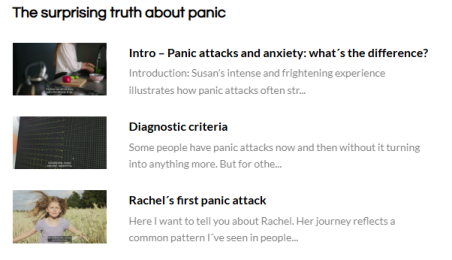
1. Understand what your body is doing
How many times have you googled a symptom, or asked AI? Here you get the whole picture at once: what your body does from the first heartbeat to the tingling and the air hunger, and why it can hit days after the stress is over. And if you’ve had the symptoms nobody mentions, like feeling unreal or jelly legs, I explain those too.
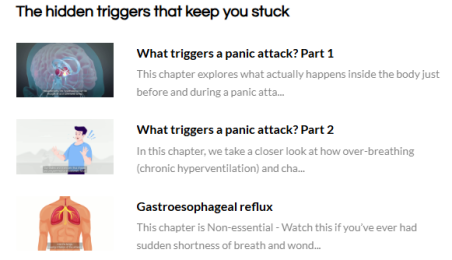
2. See what keeps your panic going
Think about what you do after an attack. Check your pulse, cancel the plan, take the long way home? It all makes sense, but, it’s also what keeps your panic coming back. Here you map your own panic on paper, and I’d bet you’ll find things you’ve never counted as part of it.
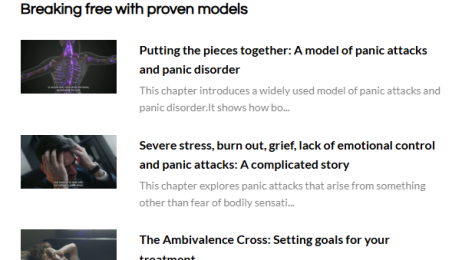
3. Change it, one step at a time
This is where your body starts reacting differently. Some of what you do to feel safe is easy to see. The ones that undo the most work are the hardest to spot, and some of them you’d swear are helping. I help you find yours, and then you start taking back what panic took, at a pace you set with the easiest thing first.
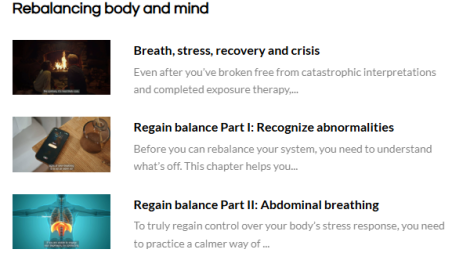
4. Making the change last
Breathing retraining comes here, at the end. By now a racing heart is no longer something you need to escape, so breathing can’t turn into one more way out of an attack. You’ll also see how sleep and stress affect how easily the alarm goes off, so the change last even after a bad week.

Three cases from clinical practice
The program follows three cases through the full mechanism: from first attack to lasting change. Each one represents a different way panic tends to develop.
Susan’s first attack happened while cooking dinner on an ordinary evening. Her heart suddenly started pounding for no reason and she called an ambulance. The tests came back normal. That explanation changed nothing about how terrifying it had felt, or about the fear that it would happen again. In the program you find out what her body was actually doing that evening, all the way down to her breathing and her blood.
Rachel’s panic built more slowly. It started the afternoon she locked up the coffee shop, when her heart started racing for no reason. Within weeks she’d stopped biking, stopped drinking coffee and turned down a party. She checked her pulse several times a day. “Control meant everything to me.” You see why her heart raced that afternoon, and then follow her as she starts working with the racing heart she’d been running from, one step at a time.
Sam’s first panic attack was on a crowded train on a February morning when he couldn’t get enough air. At the next station he pushed his way out onto the platform. After that it was trains, then buses, then driving, and he stood by the doors when he had to ride. “My body was no longer on my side.” You follow him as he goes back to the car, the train and the places he’d been avoiding, and see the fear drop a little each time.
You’ll probably see yourself in one of them, or somewhere in between. In the program you follow all three from the first attack, so you can see your own version in theirs, and what it takes to change it.
Follow-up results from program participants
I didn’t want to just tell you this works. So in the fall of 2025 I followed up with a group who completed the program, using questionnaires with validated psychological measures before and after.
On average, their panic symptoms dropped by about 73%, over roughly two and a half months. Most noticed meaningful changes within the first phase, before completing the full program.
It was a small group, there was no control group, and your results can be different. I share it so you can see what kind of change is realistic.
For full transparency, including who was included, how symptoms were measured, and what these results do and do not mean, you can read the complete clinical summary here.
~73% reduction in panic symptoms
Many participants who previously avoided subways, flights, or restaurants were able to return to those situations after completing the program.
~78% reduction in anxiety
Improvements were not limited to panic attacks alone. General anxiety across everyday situations also decreased substantially.
~83% Reduction in depressive symptoms
Many participants came in dealing with low energy, a reduced interest in things, and a sense of being worn down. When panic started changing, mood lifted as a consequence.
Here's what you get

- 38 videos, so you can watch one on a lunch break or before bed without setting aside a whole evening.
- The worksheets I use with patients, so you can see your own checking, avoiding and triggers on paper instead of guessing.
- Extra modules for symptoms that don't fit the textbook, like the feeling that nothing is real, fainting and reflux, so those get their own explanation too.
- Three clinical cases followed from the first attack, so you can see how it works in someone whose panic looks like yours.
- Your own pace, with no deadline, so you can start with the explanation and take the exposure steps when you're ready.
- Lifetime access, so you can come back to it after a bad week instead of starting over.
- 30-day money-back guarantee
Just $69
Less than the cost of a single session with a specialist, for lifetime access
Is this for you?
I built this for panic and nothing else, so I’d rather tell you now if it isn’t the right fit.
It’s for you if:
- Your attacks come on the couch, in bed or on an ordinary day, and the tests keep coming back normal.
- You avoid places, plans or things you used to love because of what might happen there.
- You check your pulse, google symptoms or plan your way out, and you're tired of it.
- You've tried breathing, apps or therapy, and the attacks still come back.
It’s not the right fit if:
- What you mainly struggle with is everyday worry, stress or burnout, without panic attacks.
- You're in crisis right now. Then you need someone working with you directly, so contact your doctor or your local emergency number.
- Your symptoms haven't been checked by a doctor. Get them checked first, and start when you're ready.
What happens after you buy?
1. You get access right away. The login comes to your email within minutes. Nothing to book and nobody to call.
2. Tonight, you watch the first video. You see what your body does during an attack, from the first heartbeat to the tingling and the air hunger.
3. You do the first exercise. You circle your symptoms on a list of fifty and write down how your last attack went. I’d guess you’ve never seen your own panic laid out like that before.
4. You keep going at your own pace. And if you get stuck on an exercise, you email me. I answer every question about the program and the exercises.
Your Questions Answered
Because of when the breathing comes. If you breathe your way out of a rising attack, your nervous system learns the sensation was something to escape, and the alarm stays on.
In my program, breathing comes last, as a change to how you breathe day to day, after the exposure work already has shown your body that the sensations are safe.
Understanding what panic is and changing it are two different things.
You probably know it's adrenaline and that it isn't dangerous. What usually got left out is what happens in your blood on a calm evening, and what keeps the alarm on between attacks: the checking, the avoiding and the reasons you give.
The program covers both, and then gives you the steps to actually change this.
CBT is one of the best documented treatments for panic. What I see go wrong is panic getting treated like general anxiety, and the steps being done in the wrong order.
These videos are what I'd go through with you in a session, in the order I watched work and that the research backs up.
Everything in the program comes from what I did in sessions, sitting across from people with panic for over a decade. You don't have to explain yourself to anyone first, and you can start tonight. If you need more support than a program can give, get it, and the guarantee covers you if this isn't it.
A lot of the people I worked with had panic for years, sometimes decades. The longer you've had it, the more the checking and avoiding have had time to grow, so your list of steps may be longer.
The steps themselves and how to change them are the same.
You don't start with exposure. You start by understanding what your body is doing, and many people find that alone changes something.
When you get to exposure, you start with the easiest step and set the pace.
Yes. On the highway, on the train or in the store, your heart races and you can't get enough air, and the program explains why your body does that.
Then you build your steps around the places you've been avoiding, and they're easier to take once you know what's happening.
You can, and you'll get a reasonable general answer about panic.
Then the next time your heart skips, you'll ask again. Here it's all in one place, in the order I'd take you through it, with worksheets for your own situation and a plan for what to do next.
Yes. The program explains what happens in the body during panic. It doesn't diagnose anything or replace a medical evaluation. If you have chest pain, a racing heart or other symptoms a doctor hasn't looked at, get them checked first. If something feels like an emergency, call your local emergency number.
You get access right away. Nothing to schedule and nothing to set up, so you can watch the first video tonight.
Try it for 30 days. If it doesn't help, email support@gspsychology.com and you get your money back. No questions.
Two directions from here
You can keep working around panic. It’s what most advice teaches, and the systems you’ve built do get you through the day. They also keep the cycle running, and over time the list of things that need a plan before you’ll do them tends to grow.
Or you can start working with what keeps it going, one step at a time, at a pace you set. You can start tonight.

Try it for 30 days
30-Day Money-Back Guarantee
If you’ve already spent time and energy on things that almost worked, I understand hesitating before trying one more. That hesitation is rarely about the $69.
That’s what the guarantee is for. Watch the videos, fill in the worksheets, take the first steps. If it doesn’t help, email support@gspsychology.com within 30 days and you get your money back. No questions.
You can keep checking your pulse, picking the seat by the door and planning your week around Saturday’s dinner. Or you can start tonight, and see what changes when you work with it in the right order.
- $69 and lifetime access
- One-time payment - no subscription
- 30-day money-back guarantee
- Instant access